Showing posts with label Syriza. Show all posts

Sunday, 17 January 2016

Finally Some Good News For Greece?

After more than eight years of being confined to the European Union’s intensive care ward with systemic, near-death, and highly contagious economic and political maladies is Greece finally ready to hobble out of bed? Although the team of EU fiscal doctors, aided by consultants from the International Monetary Fund, is not completely convinced there has been a noticeable positive shift in the tone of comments from friends and family.

We spent several months in Greece last year, and the mood was unremittingly gloomy all the time. Almost every conversation began and ended with a litany of the country’s problems: the idiocy of the government, the evil of the creditors, the collapse of the financial system, and on, and on, and on. The newly elected Syriza government, together with its tragi-comic finance minister Yiannis Varoufakis, was trying desperately to implement its version of the almost universally unsuccessful leftist economic and administrative ideology. All it succeeded in doing was to demonstrate its own incompetence and find new and unique ways to infuriate the people who were trying to keep Greece afloat. At one point, people on various islands were seriously investigating ways to secede from mainland Greece and create their own little versions of paradise.

While the underlying economic reality may not have changed very much, the election of a young, very smart, and dynamic leader as head of the main opposition New Democracy party has injected a whiff of change, the possibility of something better. Kyriakos Mitsotakis is the scion of one of Greece’s leading political families, but people should be careful of thinking of him merely as new wine in an old bottle. In addition to showing himself to be politically astute, he brings an impressive educational and professional resume to the job.
           
Kyriakos Mitsotakis -- the new leader of New Democracy
He graduated summa cum laude from Harvard and has graduate degrees from Stanford and the Harvard Business School. In addition to idiomatic English, he speaks French and German. He spent time in London working for the McKinsey consulting company. He also served as Minister of Administrative Reform in the government of Antonis Samaras from 2013 – 2015.  I met Mitsotakis several years ago when he was managing director of the venture capital arm of the National Bank of Greece. We worked on a cross-border investment project involving Greece and Turkey, and I found him smart, pragmatic, and focused on solving problems rather than advancing any particular theoretical approach.

Greece’s European partners will breathe a sigh of relief at the prospect of dealing with someone in Athens who literally, and figuratively, speaks their language. They would be making a serious mistake, however, to think that Mitsotakis will roll over and accept anything that comes out of Brussels. What they may well find is that instead of facing the profoundly unserious bombast of Syriza, they will be facing deeply analytical, thorough, and logical counterproposals to defend and advance Greece’s position. If Mitsotakis ever gets elected prime minister his counterparts in Brussels better be prepared to send the A Team to meetings with Greece.

Many of the people I spoke with on the island of Andros and in Athens greeted his victory in the race to lead New Democracy as a sign of very, very cautious hope.

“We hope, we wish,” said one shop owner. But with an expressive shrug of her shoulders she added, “But we really don’t trust any government anymore.” She, like thousands of other small businesses, is caught in the uncomfortable position of facing mounting taxes long before there is a hint of the economic recovery that could provide the money to pay the taxes.

A financial analyst in Thessaloniki said that Mitsotakis’ election has “re-energized the middle class. He is the flip-side of Syriza.” Others say Mitsotakis represents an important change in perception.

“Look, nothing fundamental has suddenly changed in Greece. Unemployment is still about 20%, the banks are fragile, and it looks like the capital controls will have to stay in place for the rest of 2016. But, in our politics, perception is very important. And right now, Kyriakos is benefitting from the perception that he may be the one to lead us out of this quagmire. The same dynamics of anger at the existing government and hope for change that brought Syriza to power in the first place could now benefit Kyriakos.”

Mitsotakis is certain to face the charge that he is nothing more than the latest manifestation of the dynastic politics that have plagued Greece for generations by focusing on punishing perceived enemies and rewarding clients rather than solving national problems. Another senior executive laughed and said ‘clients’ are nothing new in Greek affairs.

“Go back and re-read the Iliad. Homer gave the gods plenty of ‘clients’. Hera and Athena, for example, worked hard for the Achaeans while Aphrodite supported the Trojans. Kyriakos will undoubtedly face pressure from some so-called ‘clients’ but I think he is clever enough build bridges rather than simply settle old political scores.”


Under his very new leadership New Democracy has already received a bounce in the polls that puts them a few points ahead of Syriza.  It remains to be seen if Mitsotakis can ride this momentum to victory in a general election, but at this point not very many people would bet against that possibility.

Tuesday, 30 June 2015

The Greek Crisis Has Some Dreaming Of Independence -- From Athens

The only funny thing about the sad situation in which Greece finds itself is reading essays about what the Greek people ‘must’ or ‘must not’ do from renowned economists and leading academics writing comfortably from their offices thousands of miles from the turmoil. They are not the ones lurching from crisis to crisis worrying about when the money runs out, when the pharmaceuticals run out, when their pensions run out, or even if the food runs out.

Even Nobel Prize-winning economists like Paul Krugman urge the Greek people to rejectthe latest proposal from the creditors and risk leaving the Euro and returningto the drachma. Surely, he opines, this would be better than submitting to the even greater ‘austerity’ required by the creditors. Greece would be free of the creditors’ shackles and resume growth quickly. Nothing demonstrates the dangers of long-range analysis better than this.

In a perfect world Krugman might be right. If, and it is an enormous ‘if’ Greece had a smoothly functioning bureaucracy, a government determined to institute sweeping reforms, a political class not wedded to corruption and cronyism, and no deeply entrenched groups from  protected business interests to pampered public service employees with a strong interest in preserving the dysfunctional status quo such a recipe might work. But, alas, we are dealing with the reality of modern Greece and not some theoretical classroom exercise. And that sad reality is that without those sweeping reforms what remains of the Greek economy, regardless of the currency in use, will most certainly contract further.

Syriza could have been an agent of change. It could have instituted long-overdue reforms and, in the process, generated the revenue to improve the welfare of the people. Instead, it has proven to be nothing more than an extension, a particularly incompetent extension, of the failed political system that has decimated Greece over the last several decades. And the sad thing is if it had committed to these reforms it could have minimized the hated ‘austerity’. And the really sad thing is that the price of this intransigence is being borne by the very people Syriza said it wanted to help – the poorest sectors of the Greek population.

It chose instead to implement its school-boy theories, which by the way have not worked anywhere in the world, and substitute revolutionary rhetoric for real achievement. In the process their hypocrisy and deceit have succeeded only in alienating just about everyone who was in position to help. It would have been interesting to see, for example, if the creditors would have taken a softer tone if the government had moved aggressively on revenue producing reforms like privatization or breaking the stranglehold of protected businesses. But all we heard were thunderous pronouncements against such steps. One could almost hear the Euro Group, the IMF and the IMF pleading with Syriza to ‘give us something to work with.’ But the only thing that emerged were half-baked demands for debt reduction. Fine, but in return for what – precisely? I can imagine Christine Lagarde, managing director of the IMF, asking the Greek government what it would do to help itself.

One can argue that the European institutions made a serious error a few years ago by bailing out the private banks that had recklessly loaned massive amounts to Greece. How often should tax payers be required to rescue private banks that should have known better? When do they these banks have to pay the price for their mistakes? Wouldn’t it have been much better to force those foolish banks to take the necessary hair-cut to reduce Greek debt to manageable levels? The problem was only compounded when public institutions assumed that debt. All this may be true. But, as The FinancialTimes Martin Wolf puts it, those are now ‘sunk costs’ and it is time to move on.

Meanwhile the drama is played out on the streets of Greece as most economic activity grinds to a halt pending the outcome of Sunday’s so-called referendum called by Prime Minister Alexis Tsipras. The 72-word question is a ridiculous summation of complicated financial discussions that very few people can possibly understand. The legal grounds for the referendum are not even clear, because currently there is NO deal on the table. What, exactly are people voting on? Whatever the stated question may be, most people seem to understand that the real issue in this referendum is Greece’s position not only in the Eurozone but in the European Union itself.

A friend on the island of Andros had an interesting solution to his anger at the government and the uncertainty of the current situation – independence. “We should immediately declare independence from the oppressive, idiotic regime in Athens! We could build a real economy here based on out maritime history, but including other centers of excellence such as financial and health care.” All it needs now is a Declaration of Independence. We are, after all, close to July 4th.


Saturday, 9 May 2015

"If You're Going To Shoot Me, Shoot Me! Just Get On With It!"

ATHENS -- Fatigue, exhaustion and frustration seem to have descended on Greece like a cloud, dampening the natural exuberance and underlying optimism of many people. They are simply worn out by speculation on the outcome of endless negotiations that achieve nothing, the daily struggle with total uncertainty about their economic future, and the barrage of contradictory proclamations from an inexperienced government. “We are on the verge of an agreement with the creditors! There is no agreement! We might agree to privatise some state assets. We will NEVER sell or lease a single state asset!” And so it goes. Meanwhile hapless citizens are caught in the middle of a frightening maze.

“If you’re going to shoot me, shoot me! Just get on with it,” cried one anguished citizen. “I’m tired of this mess. We’ve been dealing with it since 2008 and there is no end in sight. I just want it over with, one way or the other.” One housewife said she hardly leaves the house these days. “I sit home on my sofa all day watching TV hoping to see some developments. Nothing.  All I’m doing  is wearing out sofa fabric.”

How many Greeks feel at the moment
More galling perhaps is the loss of self-esteem. “We used to be proud to be Greek. We were considered the home of democracy, the worthy heirs of the likes of Plato, Aristotle, and the great playwrights. Now Greece is considered just another unruly little country stuck onto the bottom of the Balkans. It’s embarrassing to admit that you’re Greek these days,” says one Brussels-based Greek.

In the current, rapidly deteriorating economic situation cash is king. No one knows if the banks and all their ATM machines are suddenly going to close. Tourists are advised to bring lots of cash. Many businesses are forced to pay cash for raw materials because suppliers limit credit to only the largest of companies. The central government has stripped municipalities of their spare cash in a desperate attempt to meet pension payments and pay creditors.

The Syriza government swept into power in January with the promise that it would stand up for the ‘little man’, roll back the hated austerity program, and force the country’s creditors to renegotiate a much more favourable package of repayments. This simply hasn’t happened. A lethal combination of inexperience, arrogance and party disunity led the new government to badly overplay its already weak hand.

For four months the Greek people have been living on promises of a better tomorrow. But that tomorrow keeps receding further and further into the distance. Faced with an intractable Eurozone making demands that a fractured, internally chaotic Syriza simply cannot deliver the government faces some unpalatable choices that could rip the party into its constituent parts.

            Some more bizarre members of the ruling party want to dump the whole negotiating process. They openly call for leaving the Eurozone in favour of the old currency, the drachma. They ignore the horrific costs of such a move for the average citizen they claim to represent. Among other things, this move would certainly reduce food supplies in the country. Greece imports about 75% of everything it eats and drinks. How are the stores going to pay for these goods with a sharply devalued drachma? How is the present generation of Greeks going to react to shortages it has never seen?

One ruling party MP, Costas Lapavitsas, blithely, almost cheerfully, admits – from the safety of his academic sinecure in London – that going back to the drachma would, of course, entail a return to rationing of most of life’s basic items – a condition Greece escaped decades ago. I'm not sure how most Greeks would react to standing in line with their ration cards waiting for their daily bread. He also says that Greece should re-align its foreign relations away from Europe, and by implication the United States, and cosy up to such economic power-houses as Venezuela, Iran and China. Never mind that Iran is working hard to re-join the Western world and that Venezuela is flat broke despite its vast oil reserves. Tough to see Greece doing much of deal with China after repeatedly refusing to let a Chinese company buy the portion of the Port of Piraeus it doesn’t already own. Maybe he meant Greece to copy that other Asian powerhouse -- North Korea.

While most of the world has moved on from this Stalinist economic view, it does represent a strong faction within the government, and demonstrates clearly why any agreement with the Eurozone could split the party wide open. This partly explains the hesitant, confusing approach of the Greek government toward any deal with its creditors to keep Greece in the Euro. The Syriza government itself may not have a clear, unified approach. Who speaks for the government?  Ministers are constantly contradicting each other. The government is caught in a bind. Sign a deal, break up the party. Reject a deal, lose Greece. That’s a tough choice for a party filled with people trying to run a country on the basis of revolutionary rhetoric more suited to university agitation than actually running a real country.

Does Tsipras even want a deal with the creditors?
Unable, or unwilling, to make that choice the party may resort to a referendum to solve the dilemma. Let the people choose whether to stay in the Euro or return to the drachma. Fine in theory. Difficult in reality. How exactly will the question be worded? Will the banks have to be closed during the period of the referendum to stop massive withdrawals? Will capital controls have to be imposed? Will people clean out the supermarket shelves and start hoarding just in case the country goes back to the drachma? The only thing that is clear at this point is that the resilience and endurance of the Greek people are stretched to their limits.

Wednesday, 11 March 2015

Will Greece Remain On A 'Life-Support' System?

A great deal of ink and broadcast time has been spent over the last few months on the fate of Greece. Mind you, this is a discussion that self-obsessed Greeks have been having at least since Homer, but it seems to have gained traction recently. As a very smart, very well plugged-in Greek friend explained at dinner last night, “A lot of people in Greece love nothing better than the fact that Greece is on the front pages of the world’s newspapers. While the content of this news may escape them they consider such coverage proof that Greece is where it should be – at the centre of the universe.”

            My friend, who would describe himself as a ‘realist’ rather than a ‘cynic’, says the current stand-off between Greece and the rest of the Eurozone is ‘pure theatre – nothing more.’ Both sides, he says, are playing to domestic audiences. The Greek side uses its bizarre, confrontational negotiating style to please the home audience. Given the high approval ratings of this strategy seems to be working. The optics of the  ‘little guy’ standing up to the power of the ‘big bullies’ effectively obscures the reality that the country is broke and can barely meet its pension obligations. The heavyweights of the European Union, for their part, need to show their own domestic audiences that they are not giving in to the ‘profligate and corrupt’ Greeks. They are well aware of the rising chorus of resistance to further financial assistance. “Hans will not give one penny more to those shiftless bums. If Portugal and Ireland worked their way out of the recession why can’t Greece?” So goes the rhetoric.

            The reality is a bit more complex. My friend anticipates a messy continuation of the current situation. “The creditors and the Eurozone are well aware that there is no way the current Greek government, or indeed any foreseeable Greek government, will make the necessary structural reforms to generate growth and help the country stand on its own feet. Rigid, antiquated ideology combined with deeply entrenched vested interests make such reforms virtually impossible. It’s not just Syriza, the former New Democracy government was never serious about implementing reforms. It is far more likely that the creditors will keep Greece on a life-support system by drip feeding it just enough cash to keep it within the Euro zone. Then they can forget about Greece and move on to more pressing issues. No one wants to risk a complete break- up of the Euro over a possible Greek exit from the single currency.”

            The only flaw in this argument is that the so-called ‘Hard Left’ faction in Syriza doesn’t want to play this game. They would like to drop the constraints of the Euro and return to the national currency, the drachma. The language they use while spinning around in their own little galaxy is full of such stirring phrases as ‘national sovereignty, dignity, national honour, and freedom from oppression.’ When reminded that even fellow ‘austerity’ sufferers like Portugal, the Baltic states and Ireland, urge Greece to follow through on reforms this faction in Greece says this is merely proof that Europe is not ‘ready’ for a real left-wing government. You have to remember that Greece is about the only country left where political terms like ‘Left’  and ‘Right’ are actually used in serious conversation. Most other countries have moved on to more current challenges rather than re-fight old, stale political doctrine.

            Behind the ringing calls for ‘national sovereignty’ with a return to the drachma lies a far more mundane reality. Returning to the drachma means essentially a return to the rotten old system that broke Greece in the first place. The government could simply print as much money as it wanted, regardless of its value, and reward its friends with jobs, higher state hand-outs, even more restrictive labour practices, and protective barriers for favoured industries – those that are left in Greece that is. The economic hardships faced by ordinary people would be glossed over as ‘sacrifices necessary for the common good.’ In other words, ‘Stop whinging about the lack of food on the shelves and glory in the return of Greek pride.’

            Remaining in the Euro, with all its financial constraints and empty Greek treasury, makes this type of political spending more difficult. But not impossible. “Remember all those €70 billion in non-performing loans held by Greek banks.  Do you think it is a straightforward process determining whose loans will be forgiven and whose repayment will be demanded,” my friend asked rhetorically. “I dare say there will be some interesting discussions between the banks and the government on this issue.”


            He may be right in his ‘life support’ analysis, but there is always the risk that an accident between inexperienced Greek negotiators and tired, frustrated Eurozone finance officials could push the country into the cold, hard world outside the Euro.

Friday, 20 February 2015

Who Are The Real Revolutionaries?

Buried beneath the mountain of verbiage and breathless news reports about the Greek debt negotiations lies a little-noticed role reversal. While the new Greek government Syriza adopts the dramatic plumage, media savvy and rhetoric of ‘revolutionaries’ they are, in fact, staunchly defending the Greek status quo – the very status quo that brought Greece to its knees. The usually media-shy, grey and drab Eurocrats in Brussels would shiver at the comparison, but they have become the real revolutionaries who want to change Greece and bring it kicking and screaming into the 21st century.

            The Greek state, with its bountiful patronage and rigid control, has dominated the Greek economy and protected politically loyal interests for generations. Every party in power has used the state coffers to reward voters with jobs in government or in state-owned enterprises regardless of aptitude or knowledge of the job at hand. The combination of hapless, inefficient state economic enterprises and bloated bureaucracy whose main goal was to strangle at birth any innovation that might reduce its numbers has slowly but surely deprived the Greek economy of the vitality and oxygen needed for real growth. Who in his right mind was going to spend the energy required to fight through the swamp of bureaucracy and closed professions to start something new that just might offer a lower priced, better service or product to all consumers? Far better to stuff your idiot cousin into well-protected state job.

Is he the revolutionary ...
            This is what Syriza wants to defend at all costs. It is, after all, the source of the party’s political power. And this condition is exactly what the bureaucrats in Brussels want to change. Syriza loves to play on the image of the hard-hearted Germans insisting that impoverished Greeks tighten their already tightened belts a few more notches. Greeks respond ‘What belt? I sold that long ago.’ 

Even brilliant economists like Paul Krugman weigh in against the follies of relying on austerity to bring a country out of depression. It is not every day that I take issue with a Nobel Prize-winning economist, but Krugman may be only half right in this case. I agree completely that austerity by itself accomplishes nothing but misery. How can any country, or company, for that matter prosper on a diet of nothing more than the economic equivalent of kale and tofu?

It is the flip side of the austerity coin that has been obscured in all the concern for the long-suffering Greek people. So far, Syriza and its vocal supporters have said very little about the vital structural reforms required to get Greece off the welfare rolls. What about opening up the economy to newcomers and, God forbid, foreigners? What about amending the bureaucracy to encourage instead of discouraging enterprise? We know that Syriza is firmly against selling or even leasing state assets to raise funds that could be used in much-needed social welfare programs. But why, precisely? Do the party leaders really believe that the state can run things like the railroad, ports or power corporations more efficiently than private owners? The real tragedy is that without these long-overdue structural reforms the pain of reduced spending over the last few years will be wasted. Greece will remain mired in a welfare trap, unable to claw itself out of debt and unable to grow.

Or is he the real revolutionary?
The revolutionaries in Brussels want to change the story line. They are well aware of the desperate state of many Greeks, but they would like to help Greece grow out of the welfare trap rather than remain on the EU’s life-support system. An obvious deal is on the table. Greece’s debt conditions are eased in return for real movement on the economic reforms. Will Syriza pick up this deal? Or will it continue to play the role of the defiant revolutionary defending the barricades with cries of ‘national sovereignty over all else’? One wonders if Greece’s rulers have ever explained that the price of joining the EU and then the Euro was a loss of total sovereignty. The club has rules that one is supposed to obey. One didn’t hear much about a ‘loss of sovereignty’ when EU funds were flowing in to improve the country’s antiquated physical infrastructure. But now when the club secretary reminds members that the club is joint enterprise with certain obligations we hear cries of anguish from many Greek politicians.


If there is no agreement in Brussels in the next couple of days Syriza could possibly elect to hold a referendum on the Euro. It could ask the Greek people to decide if they want to stay in the Euro even with the ‘odious’ conditions imposed by heartless Germans -  or do they want to return to the ‘proud and sovereign’ drachma regardless of the economic pain that might cause. Such a step could give Syriza political cover regardless of the outcome. In any case, we won’t have long to wait for the end of this melodrama.

Thursday, 5 February 2015

Rigid Ideology Trumps Welfare Of The People

Nothing better illustrates the ‘profoundly unserious’ nature of Syriza’s plan to revive the Greek economy than its position on the sale of state assets. Syriza’s new ministers have gone out of their way to condemn the practice and say they have absolutely no intention of pursuing any more privatizations. So much for the claim of helping the long-suffering people of Greece. If the party was genuinely interested in easing this suffering it would relax its rigid ideology and use these state assets to generate the necessary funds.

           The Wall Street Journal ran an interesting analysis of the Greek debt situation in the 20 February edition. Stephen Fidler points out clearly that Greece has the resources to tackle its debt, but the government chooses not to. This analysis would seem to be supported by comments from two leading government officials regarding the controversial privatization program.

            Finance Minister Yanis Varoufakis opined in one of his carefully-calculated sound-bites that “it is not very clever to sell off the family jewels in the middle of deflationary crisis. It is wiser to develop state property and increase its value using smart financial resources to strengthen our economy.

            Panayiotis Lafazanis, leader of the hard-left faction of Syriza, added that the Public Power Corporation “will return to the state as a state-run company which will operate as a driver of economic growth.” Are they kidding??!!

           These comments demonstrate clearly that neither of these people has ever been involved in selling or running anything, and has absolutely no idea what they are talking about. First, when is a better time to sell assets than when you need money? The government can set the minimum price it will accept and work to attract bids. Because assets like the Public Power Corporation, the Port of Piraeus, and the railway are potentially valuable for the right buyer the bids could easily exceed the state’s minimum price. The cash received by the state would come in very handy to meet some of the legitimate social needs in the country. This much is elementary, not even Economics 101. 

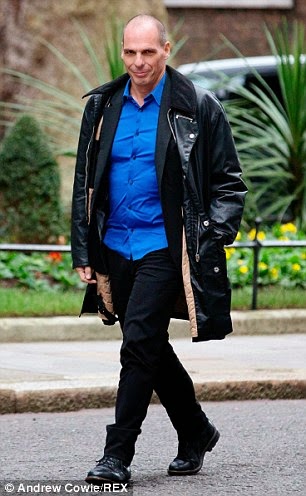
Fashion statement or finance minister?
            Second, the idea of the Greek state ‘developing’ these assets or having state-run companies becoming “a driver of the economy” is ludicrous. Over the past several decades the Greek state, regardless of the party in power, has demonstrated convincingly that it cannot run a car wash let alone something as sophisticated as a major port or energy company. Just look at the sorry record. Olympic was a decent airline until it was nationalized, starved of investment, over-staffed with political patronage, and ultimately went bust. The airline was well known for people getting paid and never bothering to show up for work. The railroad could be a very valuable asset by connecting with a potentially efficient Port of Piraeus and offering a much quicker way to the heart of Europe than taking a ship all the way through the Straights of Gibraltar and up to Rotterdam or Hamburg. But, under state ownership the railroad never even began to reach its potential. All you have to do now is contrast the part of Piraeus Port owned by the Chinese company Cosco with the state-owned section to see the difference. One bustles with activity and productivity while the other stagnates

Furthermore, all these state assets require millions of Euros of investment to make them productive and efficient. Under state ownership where is that money going to come from? The Treasury is already empty, and there will be intense pressure to spend what little money there is on re-hiring people or boosting pensions rather than buying things like a new crane for the Port of Piraeus.

            One would hope that Syriza would at least be honest with the Greek people. One reality they do not touch upon is that the party is beholden to powerful unions. And these unions have always been opposed to privatization. Such a move away from state-ownership could seriously weaken the unions’ influence. In addition, continuing state ownership guarantees Syriza’s grip on the levers of economic power in Greece. Friends can easily be rewarded while enemies can be left outside the charmed circle. One gets the distinct impression that the last thing Syriza wants is strong economic growth led by a private sector that it cannot control.

            Another way to generate some cash for much needed social programs would be to cut the bloated defence budget which is still one of the highest in NATO as a percent of GDP. Surely, if Syriza were seriously interested in helping the people of Greece it could divert some this money into much needed social spending.

             But what do we get instead of serious proposals? Grandstanding helicopter flights by the new minister of defence over disputed islets close to Turkey where he dramatically drops a wreath for all the cameras to witness. Why? What on earth was he trying to do other than provoke another problem that Greece does not need? Despite deeply entrenched Greeks fears to the contrary, Turkey is not about to lunge across the border and grab some territory

            Greece does indeed have the ability to help itself.  But the government has to get serious about generating sustainable income rather than simply bleating about Europe’s ‘obligation’ to reduce the country’s debt. If Syriza really wants to prove its 'anti-establishment'  tendencies it could actually do something to help the people of Greece rather than rely on trivialities of costume design and grand, theatrical -- but ultimately empty -- gestures


Monday, 26 January 2015

Will Greece Become Venezuela -- But Without The Oil

One can only say ‘Well Done’ to Syriza after running an energetic campaign promising the long-suffering Greek people a return to the good old days and an end to the struggle, however muted, of dragging the country into the 21st century with much-needed structural reforms. He successfully kept voter attention focused on the hated word ‘austerity’ instead of ‘reform’.  Something no one seems to want. By comparison, the former leading party New Democracy was effectively absent-without-leave during the campaign and ceded all the high, self-righteously indignant ground to the insurgent Syriza. As one observer noted New Democracy seemed tired, worn out, and basically conceded the election before the campaign even began.

            Winning the election is one thing. Transforming the rhetoric into reality is quite another. The Greek treasury is essentially empty. It is not altogether clear just how Syriza’s bold election promises will be met. The glow of victory could quickly fade once the next prime minister, Alexis Tsipras, has to deal with the twin problems of intractable creditors and an extremely fractious party whose more radical elements view the election as revenge for losing the civil war almost 70 years ago. Memories die hard in Greece. Will he be able to tame the parts of his own party that want to replicate Argentina and rip up the debt agreements and repudiate all of Greece’s debt? It’s much too early to tell.

Syriza leader Alexis Tsipras
            His campaign was filled with promises to renegotiate Greece’s debt burden, restore pensions, roll back structural reforms, and essentially remove the influence of the creditors on Greece’s internal policies. By the way, all of this is supposed to happen with Greece remaining in the Euro. Crowd pleasing stuff. Exactly what the Greek people wanted to hear. Unfortunately it has the real impact of one hand clapping.

The creditors wisely remained largely silent during the campaign. It will be interesting to see how they react when presented with Syriza’s ‘demands’. Probably not all that well. There may be room to adjust terms at the margins – possibly extend maturities, be flexible on interest rates, etc. But I expect the creditors to remain firm, initially at least, on demands for continued structural reforms to free up protected professions and reduce the highly politicized over-stuffed bureaucracy that stifles any economic initiative.

The creditors, led by the Troika of the  IMF,  European Central Bank and the European Commission, should be careful, however, because Tspiras is very skillful at changing the nature of the debate and winning the critical public relations battle. The debate will no longer be about the serial failures of Greek policy makers over the last several decades. Their inability or unwillingness to create an economic system that relies on more than state hand-outs to favoured clients will be pushed aside.

Tsipras will no doubt attempt to turn the debt negotiations into grand statements about ‘Greek sovereignty’, the ‘will of the people’ vs. narrow-minded accountants. He will attempt to broaden the argument far beyond Greece and become the spokesman for all the ‘beleaguered, debt-ridden, down-trodden’ people of Europe. Nowhere will there be any acknowledgement that the ultimate responsibility for this current Greek tragedy lies squarely with the Greek political class, or that perhaps billions of Euros of loans just might come with a few conditions. All these unpleasant facts will be buried under tons of ‘anti-bailout’ rhetoric.

This strategy just might work. He knows his opponents’ weakness very well. The bureaucrats of the so-called Troika are not very good at public communications. They act like small woodland creatures caught in the glare of head lights when confronted with media attacks. They either become road kill or retreat rapidly behind bland, bureaucratic statements that Tsipras will tear apart as he backs them into a public relations corner. He will turn them into heartless accountants intent on stripping the hapless people of Greece of their last shreds of dignity and welfare. Hedge fund managers could possibly stand up to this onslaught. But European bureaucrats and political leaders are made of less stern stuff. They will be looking for a way out. They would undoubtedly cover their retreat by saying they acted to preserve the Euro and the concept of European unity. The Germans hate the idea of bailing out what they consider the ‘feckless Greeks’, but even they may wind up bending rather than be painted as the bad guys of Europe once again.

Unfortunately, the actual welfare of the Greek people could be lost in all this upcoming theatre where high-pitched melodrama replaces real substance. Tsipras has a real opportunity to lead Greece out of its quagmire and demonstrate just how he intends to kick-start the Greek economy to provide the jobs and income the people deserve. Can he change the mind set of his countrymen from relying on state hand outs that have a short shelf life? Will be do something like this? Or will he be content with the colourful theatrics of opposition? This is by no means clear.


Monday, 5 January 2015

The Greek People Deserve Much Better

The ancient Athenian dramatists would find plenty of subject matter in modern Greek politics. The only question would be whether Aristophanes or Euripides should write the play. There’s enough material for the comedies of the former or the tragedies of the latter.

            There is absolutely no question that the Greek people have been put through the economic and emotional wringer ever since the crisis began more than five years ago. The economy has almost ground to a halt, unemployment has soared, incomes have been slashed, the best and brightest young people are fleeing the country for greater opportunities elsewhere, and popular anger has reached a thundering crescendo. People are in the mood to roll a few heads.
           
            But whose? Therein lies the question. Unlike other troubled European economies such as Spain or Ireland, the problem, and any solution, go far beyond mere economics. Should they go after the entire Greek political class whose deceit, mismanagement and self-interest over the decades did so much to bring the country to its knees? Should they lash out at the current government that has very reluctantly started a half-hearted reform program? Better yet, should they vent their anger on the usual suspects – the perfidious outsiders who have the nerve to put strict conditions on the billions of Euros they have given Greece?

                That certainly is the position of the main opposition party, the left-tilting Syriza. This is where Aristophanes would have a field day. The main thrust of Syriza’s election campaign is promises to re-negotiate the bail-out agreement, force the creditors to take a bigger hair-cut, give free electricity to certain people, increase pensions, increase spending, do away with the real estate tax, raise the minimum wage, and, by the way, reinstate the €12,000 tax-free threshold. One would love to be in the room when these masters of Greek melodrama meet with the decidedly un-melodramatic German Finance Minister Wolfgang Schäuble to ‘renegotiate’ the terms of the bailout agreement. Good luck to them.

            While Syriza’s mishmash of proposals may sound contradictory and implausible to anyone with minimal financial knowledge they are consistent with the general anti-Western and anti-capitalist dogma of the Greek left that holds everyone except themselves responsible for the country’s problems. Rather than see the State with its old patronage system of politics as the author of many of Greece’s serial catastrophes many of the Greek left see the State – which they want to control – as the country’s salvation. There is not much room for private initiative in this resurrection of a failed system.

            So far the party has been relatively silent on its foreign policy objectives. This is understandable. Generally it has favoured anyone who has loudly resisted ‘Western imperialism’. But where do they turn now? The traditional international icons of the Greek left are fading past. Che Guevara and Hugo Chavez are dead. And the Castro brothers are competing to see who opens the first McDonald’s franchise in Havana. Even Iran is in serious negotiations with the Great Satan. Maybe they can turn to Kim Jong Un of North Korea. Or there’s always Hamas.

            Syriza maintains that it wants to remain in the European Union and the Euro. But it’s difficult to see how this goal is compatible with its demands of restructuring the bail-out package and back-peddling rapidly on even the small reforms that have been taken. What will Syriza do if the so-called Troika (European Commission, European Central Bank, and the IMF) refuse to budge? Will it stamp its feet and threaten to pull Greece out of the Euro? While the destabilizing effects of such a move are less than they were three years ago the thought of a member country leaving the Euro still makes people nervous. The idea of Greece back in the drachma may thrill the zealots. Others view it as collective suicide.
Syriza leader Alexis Tsipras: Backwards to the future?
            One hardened cynic in Athens says maybe it would be a good thing if Syriza wins. “Then,” he adds, “the Greek people will finally see that the Left has absolutely no answers. There is no money, no room for them to manoeuvre. There may be a fig of leaf of some debt rescheduling, but there won’t be any fundamental change in the conditions for further financial aid. Once the Greek people grasp the reality that there is no return to the old days they might just accept some serious reform.”

            Right now the election campaign seems locked in what The Wall Street Journal calls ResponsibleStagnation or Reckless Collapse. If Syriza represents the Collapse part of the headline, the government of Prime Minister Antonis Samaras represents the Responsible Stagnation. Indeed, the prime minister has never really pushed the reform agenda demanded by Greece’s creditors. He seems to present a picture of a weak person forced by unreasonable people into something he personally would rather not do. The result is that his opponents have been able to focus on the dreaded austerity instead of the much needed reform.  I haven’t heard anyone make a virtue out of the demands for reforms, and loudly proclaim that Greece has no choice. That the only hope for its young people is to break with the destructive old ways and build a new political and economic system.


Prime Minister Antonis Samaras: How much reform does he really want?

            Polls say the election will be very close. Syriza holds a small lead over New Democracy of Prime Minister Samaras, but many voters say they are undecided. The most likely outcome is a narrow victory with the winner forced to form an unstable coalition. There could well be another election this year before a stable government can be formed.


The stakes are huge, especially for the young generation of Greeks who would much prefer to remain in their native country rather than be forced to take their talents all over the world. There is no shortage of brilliant people in Greece. The real tragedy, suitable for Euripides, is that the existing political system does its best to reduce that brilliance to a weak candle glow. Time for things to change

Sunday, 10 June 2012

Which Greece Will Show Up?


Which face of the Greek electorate will show up at the polls next Sunday in the second general election within six weeks? The angry, petulant, anti-everything voters who cast their votes for the extreme left and right in a fury of protest against the so-called ‘establishment’ blamed for bringing humiliation and poverty to Greece? Or will the slightly more sober side of Greece, afraid of being isolated and scorned outside the Euro,  hold its nose and vote for the charisma-challenged Antonis Samaras and the other parties ostensibly in favour of maintaining the tough reforms required to keep Greece in the Euro?
Will This Greece Win ?
This national schizophrenia was clearly seen in the latest polls that show a neck-and-neck race between the traditional centre-right New Democracy with its muddle-through policies and the anti-everything coalition of vaguely leftist groups under the banner of Syriza. The election rhetoric, if anything, has increased since the inconclusive results of the May 6 election when no group got enough votes to form a government.
Tourists Are Choosing The Baltic Over This
 While the politicians dither the economic situation deteriorates rapidly. The country is running out of money. Unemployment is at record levels with the proportion of young people without jobs topping 50%. Banks are paralyzed, and most sources of liquidity have dried up. Tourism bookings are dropping like a stone with many Europeans deciding that the North Sea or Baltic beaches are suddenly more attractive than Mykonos or Santorini.
No Comment Required
 Syriza’s cunning plans for breathing life into the comatose Greek economy range from unwinding all the half-hearted reforms made to date to increasing taxes on the rich and the shipping companies. Syriza conveniently ignores the fact that the rich and the shipping companies are much smarter than politicians and will always stay at last three steps ahead. Essentially, Syriza wants to maintain the very system that brought Greece to its knees. The only difference is that Syriza people would be in charge of the patronage.

New Democracy and its supporters don’t really have much to say, but thunder on anyway about the disastrous consequences of leaving the Euro. They say that only they can achieve the unachievable – have the creditors moderate the terms of the reform program and keep Greece in the single currency. Left unsaid in the New Democracy campaign is the humiliating reality that northern European technocrats will continue to exert enormous influence on the Greek economy and public administration.

The extremist parties have no real program other than yelling invective at each other, throwing glasses of water, and getting into slug-fests on television. The head of the neo-Nazi Golden Dawn party was quoted as saying he really didn’t believe in elections in the first place, and that they haven’t done any good for Greece.
Political Debate Greek Style
 International economists, like an ancient Greek chorus, offer a steady drumbeat of unsolicited advice. Most of them think Greece should leave the Euro and take its chances with the drachma. This might work if Greece had anything to export or had the industrial infrastructure to replace expensive imported goods with domestic goods. But it doesn’t. Other pundits wring their hands in desperation and moan that Europe really ‘should do something, anything’ to keep the grand Euro dream from becoming a nightmare. Unfortunately, they don’t really have a clear idea about exactly what should be done, or what could be done given the political realities of the European Union.
Will The Drachma Return?
There are faint whispers that voters just might opt for the reform program they know rather than jump into the unknown with Syriza. This theory says that Greek voters got all their complaints and frustration off their chest in the first election, but will ‘come to their senses’ in this election. Maybe, maybe not. But it is quite possible that the physical aggression shown by the neo-Nazi party Golden Dawn during a TV show might have shocked people into realizing the danger posed by extremes of either wing. Many people remember the vicious civil war that Greece suffered not that long ago, and they have no wish to repeat that particular tragedy.

There is another theory that says Greece would benefit from a total collapse that would force the entire system to be rebuilt from the rubble. As one Greek friend pointed out, the problem with this theory is who, exactly, would do the rebuilding. There is no obvious or credible alternative to the discredited existing political establishment.

Is there room to re-negotiate any terms of the existing program? The Germans continue to talk tough, but could this change slightly after the elections? The head of the IMF, Christine Lagarde, had a good point that may gain some traction. Her idea was to ease up on the budget cuts and give priority to the structural reforms that must be changed if the Greek is to have a chance to grow.  Maybe there is room to shift the priorities of the program and stretch out the savings program to ease the immediate pain.

The May 6 election seemed like a wake-up call for many Greeks. They were driven to the edge and didn't like what they saw in the abyss. This is their chance to pull back and return to the hard, long-term task of reforming their beautiful country.

Friday, 18 May 2012

The Hugo Chavez Of The Aegean


Few people understand modern Greece better than Nicholas Gage. In his poignant and powerful book Eleni he tells the story of growing up in a mountain village in northern Greece during the Civil War in which his mother was executed by communist guerrillas. He knows his Greek demagogues and extremists better than most.

When he calls the rising star of Greek politics ‘daring, cunning’ and ultimately very dangerous for Greece it is worth paying attention. His column in Friday's International Herald Tribune  puts Alexis Tsipras, leader of the rapidly rising radical party Syriza, squarely in the tradition Alcibiades in ancient Greece and Nikos Zachariadis, leader of the communists during the savage Greek civil war.

 In the inconclusive election on May 6 Tsipras brilliantly played to the anger millions of Greeks feel about the destruction of their comfortable life style.  His party’s vote increased sharply as he outmaneuvered his clumsy opponents at every turn by constantly re-defining the debate. According to him it is no longer about reform of the sclerotic Greek state. It’s all about the ‘austerity’ that the evil Troika has forced on Greece or about the evil politicians that agreed to the reform program. Many polls put Syriza in the lead for the second election on June 17.

His brilliant solution to Greece’s problems is to hire yet more civil servants (all of whom will naturally vote for him in the future), nationalize the banks, increase taxes even more, and stop all the feeble attempts at privatization and liberalization of the economy. Basically he wants to take Greece back to the conditions that created the mess in the first place.

Who is going to pay for all this? In his brave new world Greece can renege on the reform program arranged with the Troika and somehow still remain in the Euro. If, and I admit it is a big if, the European leaders stick to their guns Greece under Tsipras will simply run out of Euros early this summer. Then, in order to fulfil his extravagant promises, he will start printing drachmas­ – lots of drachmas.

But he does have one great advantage over the bureaucrats in Brussels. Party leaders like Tsipras love confrontation. They thrive on it. European Union bureaucrats hate confrontation. They want everything settled quietly and politely around long conference tables arrayed with bottles of water and neat little note pads. Tsipras could well hound them into submission with his unrelenting polemics. Jean Claude Juncker, head of the Euro Group, has already started to run up the white flag of surrender by saying that they should take another look at the Greek agreement.

The negotiating style is well known. Demand, shout, demand again, never compromise, stay there all night if you have to, shout and bang the table until your opponents give up out of sheer fatigue and hunger. This is the all-or-nothing approach where compromise is a four-letter word.

In short order, Tsipras would become the Aegean version of Hugo Chavez of Venezuela and Christina Fernandez of Argentina by riding a wave of economic populism to strong election results. Unfortunately the same wave that carries him to the top will come crashing down  on the long suffering people and bury them for a long time.  

In the old days he could play the West off the Soviet Union and basically blackmail one side or the other to support him for geo-political reasons. Now, this is much harder to do. It’s extremely doubtful that either Russia or China would volunteer to take on the Greek headache.

The investment vultures are waiting eagerly for this Greek collapse. I have been told by more than one person over the last several months that they consider a Greek default and a return to the drachma as inevitable. “Things are going to get a lot worse fairly soon. Then the prices could be interesting.”

Gage sums up the hard realities facing a Greece under Syriza.

“Yet many Greeks look to Alexis Tsipras as the leader they have been waiting for – bold, daring, cunning. What they don’t realize is that he is also very dangerous, with a vision for Greece that will isolate it from the rest of Europe and reduce its people to the kind of poverty they have not seen in half a century.”

It is nothing but very cynical deception to attempt to delude the Greek people by claiming that a repudiation of the reform program will improve their economic situation. It won't. Such a repudiation would cripple an already weak economy. The real tragedy would be to give up on reform before it has even begun to bear fruit.