Showing posts with label Bordeaux. Show all posts

Thursday, 4 May 2017

Forget Politics For A Moment. Food Is The Real Passion In Most Of France.

LIBOURNE, France – This town in the heart of the Gironde region of southwestern France sits on the bank of the broad Dordgone River and is surrounded by some of the most expensive vineyards in the world.  Names like Petrus, Cheval Blanc, or Figeac are just some of the names that attract very deep-pocketed wine buyers from all over the world.

But most of the time vineyards are a sedate sort of business. Major activity seems to come in spurts at different times of the year, and there is almost a reverential attitude toward the vines. The vines and the red gold that comes from them are discussed in the hushed tones that one might expect in a church or a Swiss bank vault. But then again, you might have to open that vault to buy a bottle or two.

No, for real activity and a real sense of La France Profonde – Deep France -- one must visit the open air market that takes place three times a week in the arcaded center of the town. In this market and others just like it across the country you get a real sense of what  French people consider important – food. It’s not just food, however. If the spirit moves you can pick up a nifty hat, a pair of shoes, a shirt, a couple of plates or just about anything you can think of.
Food markets have been held in this square for centuries
Seeing the food is one thing. Actually getting what you want, however, is something altogether more difficult. You are competing against experienced French housewives with massive carrier bags or pulling trolleys the size of your basic Range Rover intent on getting that luscious looking entrecôte you had your eye on. Their strategy and aggression would put the French national rugby scrum to shame. Just as you think you have caught the eye of the butcher a sharpish elbow to the ribs takes you momentarily out of the game. A few more incidents like that and you might just join their husbands who have long ago learned the futility of offering an opinion on a certain vegetable or piece of meat. They have now been relegated to a special section where they sip their coffee while waiting to be told where to go next.


Good luck getting that cut of meat you wanted
And the food is discussed with real passion. The different cuts of meat or poultry, the quality of the animal or what it ate are discussed with an almost religious fervor that the Jesuits would appreciate.  And the debate is no less fervent for the fruits and vegetables. “Well, of course, you do understand, don’t you, that while the Spaniards do produce strawberries, one isn’t quite sure exactly where they come from or how they’re grown.”  The stall holder will then inform you of the provenance of his own strawberries and how they come from a long line of good respectable French strawberries.
If you don't want the meat there's always the daily fresh fish catch

            And then there are the cheeses. None less than Charles de Gaulle moaned about the difficulty of running a country that had at least 246 different types of cheeses. He had a point. Just about all of those varieties, and then some, are on display, and you are encouraged to sample the subtle – very subtle – differences between this brie or that brie, Comté aged for different lengths of time, and many, many more.


Is this what makes France difficult to govern?

           Now that the taste buds in your mouth are clanging like church bells you move on to the shell fish. Huge baskets are over-flowing with oysters, clams, or scallops from the Bay of Arcachon about an hour away on the Atlantic coast. You think about buying some. And then you think again about your skills of opening an oyster without slicing off at least one of your fingers. Best leave that task to the experts.

            While my wife is off haggling about the price of fresh asparagus – white or green -- in her perfect French, I head to the nearby stalls filled with fresh paté. My French isn’t awful, but I have to admit that the names of some of the ingredients of these patés escaped me. I just nodded sagely, took the offered sample, tried not to gag and moved smartly onto the instantly recognizable foie gras.

            By this time your shopping bag is feeling a little heavy and it’s time to look around for a friendly patisserie that would offer a chair and a coffee to go with that nice looking, fresh pain au chocolat.  The first one went down so well that it had to be followed with another. Finally, it was time to lug the stuffed shopping bag, now containing the obligatory baguette or two, back to the car and head home.

            Now the real challenge begins. Just what do you do with all your purchases that seem to include enough food to feed several small countries? Well, this is France, after all. And figuring out what to do with food is something they do very, very well.


Sunday, 16 October 2011

The Joy Of The Harvest

Everyone holds his breath while the expert gently and painstakingly chews the grape. Does it have just the right amount of sugar? Are the tannins tasted in the pips and skins developed to just the right level? As the expert chews slowly, looking to see how long the astringency of the pips stays on the tongue, heads bob up and down almost in time with each chew.


Finally the verdict is in. “Let the vendange begin, NOW.” At that moment every friend the grower can find is called into duty to go carefully down each row snipping off bunches of the plump, deep purple grapes and dropping them into a bucket. As the buckets are filled, cries of “Porteur!” ring out and burly young men go down the rows emptying the buckets into large containers that are in turn emptied into machines that pump the grapes into the fermentation vats.

This goes on for most of the morning and then the assembled workers repair to the garden for a good sized lunch accompanied by copious amounts of wine and followed by several varieties of sweets. Needless to say production in the afternoon falls off just a bit.

We joined our friends Joep and Mireille Bakx and their daughter Audrey on their vineyard Clos Monicord in the small town of Verac, just east of Bordeaux for the last part of the vendange late in September. Last spring we spent almost two months there doing the basic agriculture to prepare the vines for the growing season. It was rewarding to see that all the pruned vines fastened carefully to new wires, supported by new stakes driven deep into the rich Gironde soil, had grown steadily and now were filled rich bunches of merlot, cabernet sauvignon, cabernet franc, and malbec grapes. Having spent so long last spring pulling the thick, pruned vines out of the wires I must admit to a slightly jaundiced view of the lush new growth. All I could think of was the mammoth task of pruning, stripping and fastening the pruned shoots waiting for us in about five months time.


Joep with a healthy bunch of merlot grapes
The weather had been unsettled for much of September, but the last week of September and the first week of October saw nothing but sunshine and summer-like warmth. Perfect for the harvest. While friends and family can be relied upon to pick the grapes in the small one-hectare plot, the remaining 25 – 30 hectares (about 65 acres) require a machine to gather the grapes. Once picked the grapes are pushed onto a conveyor belt where we would pick out extraneous leaves or twigs. We were assisted on this task by our friends Frank and Sunny Velie who joined us from New York. From the conveyor belt the grapes are fed into the 10,000-liter vats for the all-important fermentation.


Audrey and Mariella sorting the grapes
This is one of the key areas where the skill of the wine maker comes into play. How much yeast do you add to convert the sugar into alcohol? How rapidly is the juice extracted from the must, how much oxygen is allowed into the process, what is the temperature of the juice in the vat, what is the density of the must? How many times and at what speed do you circulate (pump out and then pump back in) the juice in the vats?

The answers to these questions depend largely on the taste that the wine maker is trying to achieve. It’s difficult to say there is only one way to make wine. Neighboring vineyards with almost identical terroir and grapes can produce very different wines depending on the preferences of the wine maker. What particular flavor is he looking for? How much tannin (a natural compound giving the wine a more astringent taste), how fruity, how ‘round’, and how much of the all-important ‘structure’ or ‘body’ is the wine maker trying to achieve?

Once the fermentation is completed, in about three weeks, most of the red wines in Bordeaux are placed in 225-liter barrels made from French oak where they will mature for a couple of years. The second fermentation, the malolactic fermentation takes place naturally in the barrels as the temperature rises and the acidic malic acid is converted into the softer, rounder lactic acid. The oak flavor found in so many wines can be somewhat regulated by the amount that the barrels are scorched – heavy, medium or light.

If the whole process from the basic agriculture to the harvesting to the fermentation to the maturing, to the bottling and, ultimately, the marketing sounds like a great deal of work, it is. This is one of the reasons why so many growers in Bordeaux are getting out of the business or relying simply on selling their grapes or bulk wine. Marketing now requires a global approach, and Joep travels frequently all over Europe and Asia introducing his wine to new customers. Each country has different regulations on importing wine, and the paperwork can mount rapidly. Owning and running a vineyard is definitely not a hobby or something to 'mess around' with in one’s retirement. It’s a full time job, and then some.

However, we the consumers can benefit from the number of smaller vineyards run by people like Joep dedicated to the art of making very good wine. We also benefit because many of these vineyards are not in the well defined regions called appellations where the prices can sky-rocket according to the reputation of the appellation in general rather than the quality of the individual wine. All it requires is a bit of pleasant experimentation to find the wine that fits your own taste. And you can do this without breaking the budget.

Tuesday, 12 April 2011

Rely On The Wine In The Bottle, Not The Price On The Label


You have carefully tended to the soil, inserted new stakes, planted new vines, spent days pruning the old vines, strung thousands of meters of wire, and tied down each sprout. The buds are starting to sprout their first leaves, and soon it will be time to prune the first grapes. You will carefully attach the growing vines to the wires as they grow to more than a meter above the stalk of the vine. Then, as all farmers do, you will pray for good weather. If all goes well you will harvest rich, sweet grapes in the fall.
Domaine de Valmengaux

Then you will carefully make the best wine you can. After it has finally gone into the new oak barrels you will face perhaps your biggest challenge. What exactly will you do with the thousands of bottles you have produced?

With about 13,000 grape growers/wine makers producing 800 million bottles annually Bordeaux is easily the largest wine region in France, but it is by no means alone. Other regions like Burgundy, the Loire valley, the Rhone all have their distinctive grapes and superb wines.  Then there are the major wine producers like Germany, Italy and Spain, not to mention the so-called New World wines of North and South America, Australia, and  New Zealand. On top of all this global competition the domestic French market for wine is shrinking. Optimists will tell you that although the French are drinking less wine overall, they are drinking better, i.e. more expensive, wine.

Your task is made even more complex with a classification system in the Bordeaux region that cynics say merely supports higher prices in regions that may or may not produce superior wine. The classification system for Bordeaux wines began in 1855 when Napoleon III wanted to impress visitors to the Exposition Universelle de Paris and requested a classification system for Bordeaux’s best wines – based on price and reputation. The classification of these five vineyards – Chateau Latour, Chateau Margaux, Chateau Lafite (now Chateau Lafite Rothschild), Haut-Brion, and Mouton (now Chateau Mouton Rothschild) – has not been changed in 156 years, and there is no sign of it changing anytime soon.

A more detailed classification system for different regions, appellations, was introduced in the 1930s and includes well known regions like St- Emilion, Pomerol, Graves, subdivisions of Medoc like St Julien and Paulliac, and many others. Similar to the 1855 classifications these regions were established according to price, reputation, and the all-important political clout of the local vignernon. The prized – and pricey – St Emilion appellation is one of the larger ones and produces about 9 million bottles a year. This presented a problem for the very top of the heap like Cheval Blanc and Ausone who did not want to be lumped in with the lesser known brands in St Emilion. So this appellation is further subdivided into 1er Grand Cru Classe A (Cheval Blanc and Ausone), 1er Grand Cru Classe B (11 vineyards including Angelus and Figeac) and mere Grand Cru Classes – the remaining 55 vineyards. Any vineyard not fortunate enough to be included in an appellation is dumped into the general Bordeaux or Bordeaux Superieur classification. And this is precisely where great values can be found.

Faced with very stiff competition, rigid classification system, and declining prices for ordinary wine many of the Bordeaux vignernons don’t even bother competing. They either sell their wine wholesale to dealers who stick a label on it or they sell grapes to the cooperatives who make the wine and market the wine under different labels. Wines sold this way are not allowed to have labels that include the all important mis en bouteille au chateau – bottled at the chateau – or use words like Chateau, Domaine, or Clos in the name of the wine. This type of production accounts for about half the entire Bordeaux production, and these vignernons are lucky to get a wholesale price of €1.50 per liter for their efforts.

At the very top of the pyramid are the great names like Haut-Brion, Petrus, Cheval Blanc, Ausone, Margaux and others who can sell their wine for hundreds if not thousands of Euros per bottle. Much, if not all of their production is sold even before the wine is bottled. How much of this is attributable to great wine and how much to very, very skillful marketing is a question that continues to generate a great deal of debate in the wine industry. At least one scornful (envious?) competitor says these prices are merely taking advantage of naïve consumers looking to impress their friends rather than actually enjoy the wine.

In the middle between the wholesale producers and the lucky ones included in a particular appellation are thousands of growers making their own wine and struggling to find a niche in a crowded market. Some come from families that have been in the wine business for generations and others have come from varied backgrounds drawn by the lifestyle and challenge of making a good wine.

Vincent Rapin of Domaine Valmengaux was a jazz bass guitarist before coming to the Bordeaux area about 10 years ago when he bought about 5 hectares of vines and began making organic wine. He says it was partly a life-style decision for himself, his wife and their three children and partly the opportunity to pursue his interest in organic wine production. “We have the life we want to have.”
Vincent Rapin

Joep Bakx, owner of Clos Monicord, had a very successful career managing major hotels in several European cities and bought Clos Monicord 10 years ago. Last year he bought an additional 15 hectares, gave up the hotel management business and became a full time vignernon. It is a true family enterprise with his wife Mireille and daughter Audrey playing key roles in the company. Again, it was the lifestyle as well as the opportunity to make good wine that encouraged the move. After an exhausting day in the fields we would sit on the porch with a glass of wine watching the sun slowly set while a thick steak was grilling on the barbeque. “You know, this really is a good life style,” he would exclaim.
Audrey and Joep At His Birthday Party

But how do growers like Joep and Vincent actually compete and succeed in this market? “The first, and most important requirement, is to make a very good wine that you can sell at a reasonable price,” says Joep. A “reasonable” price for many of the smaller growers is €15 - €20 per bottle compared with the sharply higher prices commanded by wines from any of the well known appellations. One of the reasons the smaller growers can do quite well with the lower prices is that their major investment – the land – is so much less expensive. Many vineyards in St Emilion, for example, would sell for more than €1 million per hectare – if you could find any for sale. Very good land about 10 miles west of St Emilion with virtually the same soil composition sells for a very small fraction of that amount. In addition to a much more reasonable price for the land your profit margins are increased by doing most of the work yourself and valuing your time at about 15 centimes per hour.

Like many of the smaller growers they prefer to market their wine themselves rather than rely on the negociants, dealers, or sell in bulk to supermarkets where wine can be found for €2.50 per bottle. For their part the dealers prefer to sell appellation wines because of the higher prices. One London dealer somewhat ruefully explained to me that while he knows there is real ‘value for money’ in wines labeled Bordeaux or Bordeaux Superieur he doesn’t make the effort because it is so much easier, and more profitable, to sell high priced wines from a well known appellation.

Joep and Vincent each export the vast majority of their production. And this means a constant round of wine fairs, meeting with importers, sommeliers from major hotels and restaurants, and other major buyers in an effort to demonstrate the quality of your wine, to differentiate your wine, to educate the customers that good wine does not have to cost hundreds of Euros per bottle.

“The customers need to learn to focus on the wine in the bottle and not the price on the label,” Vincent says.

These education efforts require time and a great deal of travel. Joep and Audrey loaded up their car with a few cases and drove more than 11 hours to a wine fair in Amsterdam. There he arranged sales to an importer in Holland, met with importers from Belgium, and renewed other contacts in the food and beverage business. Trips to other countries in Europe and Asia are on the agenda. Other than the fairs he arranges tastings for importers and journalists in the wine trade to introduce Clos Monicord and convince them of its quality. When not in the fields or travelling Joep, Mireille and Audrey are on the phone following up leads from their extensive contact list. In short, they are trying to build demand for his wine from the ground up.

For his part, Vincent spent the better part of a week at a fair in Dusseldorf where he too met with existing and potential customers. He is planning a trip to China, a country that has become one of the biggest buyers of  Bordeaux wines.

“They are in the early stages of wine buying and still rely largely on the major names. But they have 5,000 years of history, are very smart, and will soon learn the value of more moderately priced wines.”

Both these growers admit that the selection of a good wine can be confusing for a customer looking for a decent bottle to go with his dinner. Where does he start? Reading the label closely is useful to understand what you’re drinking. Then experiment with moderately priced wines until you find one you really like. Watch out for the cork. A bad cork will allow too much oxygen into the bottle and essentially ruin the taste of the wine. Don’t be afraid to return the bottle. When this happened to me in London the dealer readily accepted it and explained that at least 8% of the corks are bad and leave the wine tasting very strange.

Don’t be intimidated by all the self-proclaimed wine gurus. Find something you like, and you will enjoy having a second bottle with your meal. Drinking wine is supposed to be enjoyable, not a test of your sophistication. And as you drink it spare a thought for the grower who worked so hard to produce the wine and make sure it got into your hands. It really was a labor of love and respect for the product.

Thursday, 31 March 2011

Bordeaux: A City With Much More Than Wine To Offer

One of the real benefits of helping friends in their vineyard in southwestern France is that when you are not slogging away amid the vines or sorting out hundreds of meters of thin stainless steel wires there are countless ways to occupy yourself.

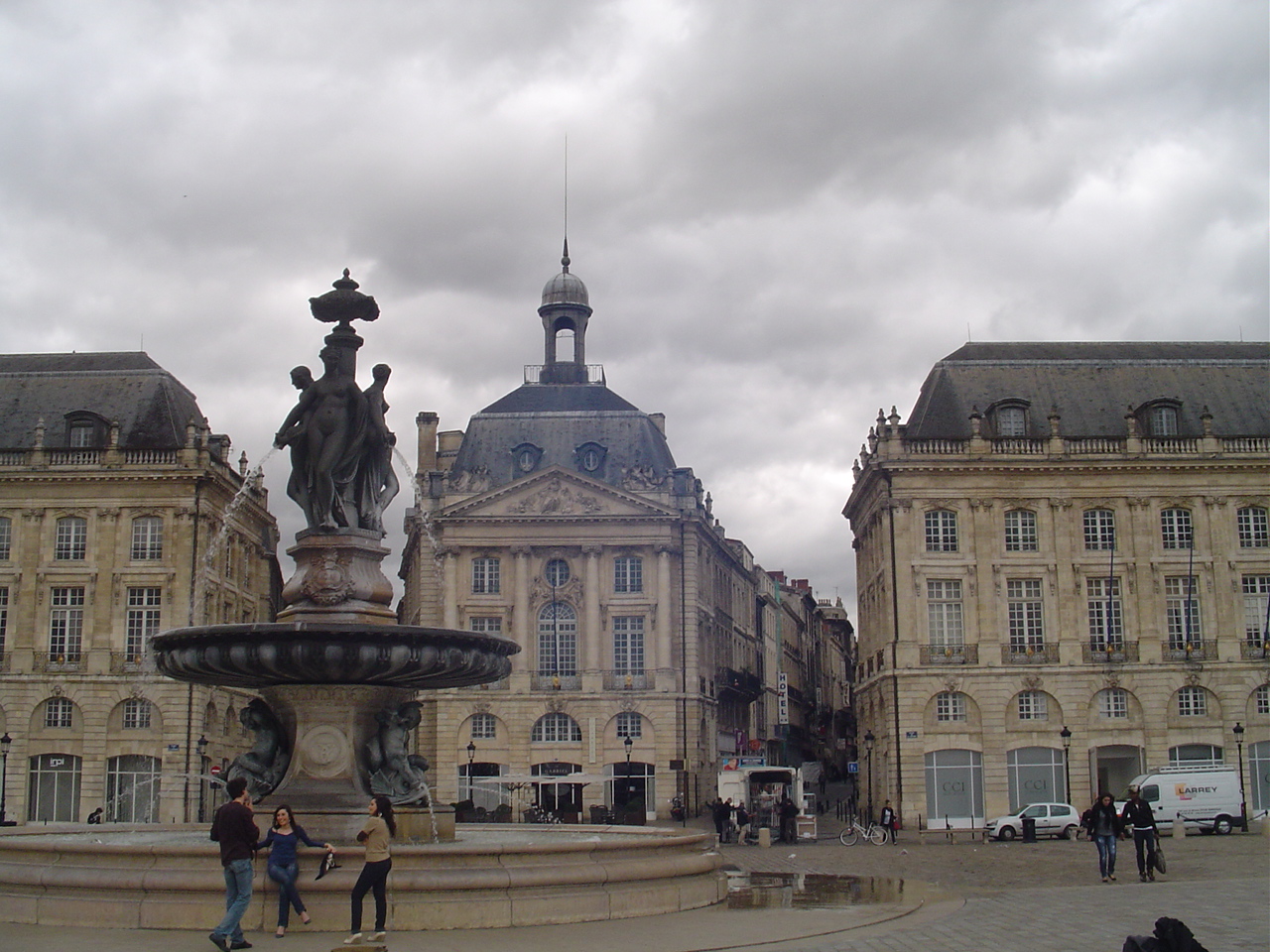
Well known to people in the wine trade, the city of Bordeaux is less well known to travelers who limit their time in France to Paris or the Provence beloved of travel brochures. They are missing something by overlooking this revived riverfront city of stunning 18th century architecture, wide pedestrian streets, parks, restored waterfront, active cultural life, and, of course, good food and wine. During the last few decades most of the old buildings have been cleaned, restoring the soft yellow/gold color of the Girondin stone.

By the early 18th century the city was thriving with one of the busiest ports in France sending wine and other products all over the world. The less salubrious side of this trade was an active slave trade where ships from Bordeaux would take part in the infamous Triangle Trade between Europe, Africa and the Caribbean. With the city’s increasing wealth the city fathers and the royal representative, the Intendant, transformed the crowded, cramped medieval city by tearing down old walls and expanding the city with about 5,000 new buildings, among which are the Hotel de Ville, Place de la Bourse, and the Grand Theater. For those who favor the narrow twisted streets of medieval Europe there is still plenty left in the older sections of Bordeaux to satisfy the most avid devotee of the 15th century.

The 18th Century Grand Theater
The revolutionary fervor that swept over France in the late 18th century put an end to this phase of renovation, and the city struggled to come to terms with the new regime. Although the residents were quick to change the name Place Dauphin to the Place de la Republique, they remained ambivalent about the revolution. As soon as possible the name of the square was changed again to Place de la Nation and, finally, to the politically acceptable Place Gambetta after the late 19th century premier Leon Gambetta. Plans for a massive structure honoring Louis XVI were shelved when the architect was told that perhaps it was not the best time to honor the unfortunate Louis as he was being trundled out to the guillotine in Paris. The political dexterity of the Bordelais can be seen the multiple names for many areas. A handsome square might now be called Place de la Bourse, but right next to this sign are the older names of Place Royal and Place de la Liberte. One can’t be too careful.

Place De La Bourse
Bordeaux was also the temporary home of the French government in 1870, 1914, and 1940 when it decamped from Paris during wars with Germany. During the German invasion of June 1940 the city was inundated with refugees and witnessed the heroic act of the Portuguese consul, Aristedes de Sousa Mendes, who, against the wishes of his own government, issued 30,000 visas to Jews and others desperate to get out of France ahead of the Gestapo. De Sousa Mendes’ act of conscious cost him dearly. The Portuguese dictator Antonio de Oliveira Salazar immediately dismissed him, he was driven out of his legal profession, and left penniless. He died in poverty in 1954. It wasn’t until much later that his name and reputation were resurrected. In 1966 he was recognized at Yad Vashem in Israel as the Righteous Among Nations. In 1987 the Portuguese finally granted him the Order of Merit, and a few years later he was restored posthumously to the diplomatic corps and made an ambassador.

Assuming you have ‘done’ the city you can always travel about 45 minutes to the wide, pristine Atlantic beaches that stretch for miles from Cap Ferret in the south to the mouth of the Gironde River in the north. If you prefer more sedentary pleasures to cycling or swimming there are several good restaurants in the town of Cap Ferret that overlook the Bay of Arcachon, famous for its oyster beds. The area is extremely popular with the Bordelais and it can sometimes be a challenge to get a booking in the middle of summer. However, just a little way out of town are a number of what can best be described as shacks with rickety piers jutting out into the bay where you can dine on a plate of oysters, pate, a little wine and freshly baked bread. All this for about €12.

Venturing just a little further you get to the Ile de Re, about 20 minutes from La Rochelle. Again, pristine beaches and small harbors like St. Martin de Re that have been tastefully transformed from fishing villages to tourist destinations. Proximity to La Rochelle and Paris via the TGV make Ile de Re popular year round. It was difficult enough to get a restaurant booking on a chilly weekend in March, and I hesitate to think what July and August might be like.

St. Martin On Ile de Re
If you’re feeling a little peckish you can always visit the rich food markets found throughout the Gironde region. It can take the better part of a morning following your wife around the markets sampling a little of this and a little of that, listening to her chatting to the farmers about the quality of the asparagus, bemoaning the lack of taste in Spanish strawberries compared to the native French varieties, and finally settling on a certain number of vegetables and a leg of new season’s lamb. Thus heavily armed Mariella is ready to go home and prepare dinner for some friends and introduce them to an ancient Greek way of preparing a leg of lamb, marinate it in milk and honey for the better part of day and then slowly roast it.

After this brief hiatus it is back to Clos Monicord where there is always something that has to be done.

Wednesday, 16 March 2011

Wine Is An Expression of Nature

One of the many traditions and regulations governing production of wine in the Bordeaux region is that you can water vines only when they are newly planted. All the rest are at the mercy of natural rainfall. While this might seem to put France at a disadvantage to other wine producing countries like Australia and the United States where growers can irrigate at will, it makes perfect sense to at least one Bordeaux producer.

“If you believe in the concept of terroir, as we do, then you must rely on nature and not artificial irrigation. Terroir  is the unique combination of topography, climate, and soil that makes our wines distinct. Maybe the terroir  in some places is not suitable to wine production and they have to rely on irrigation. Wine is an expression of nature, and we must respect nature,” said Vincent Rapin, owner of  Domaine de Valmengaux.

However, because Joep Bakx at Clos Monicord planted more than 2,000 new merlot  vines this year we were faced with a large watering task. Each of them had to be watered – by hand. This involved a tractor towing a large water tank with someone, - his daughter Audrey, me or his wife Mireille – manning the large diameter hose from the tank and giving each plant about two liters of  water. This was to ensure that the young roots were secured and headed deep down into the rich limestone and clay rather than splay out sideways.

While waiting for the tank to get refilled I could always join my wife Mariella and pull more pruned vines apart and place neatly in the middle of the row. If that didn’t take up enough time I could always help string new wire at a higher level than the old wires. The higher the wire, the higher the leaves grow, the higher the leaves grow the more sunshine they get, and the more sunshine the leaves get the more sugar the grapes get. All very nice in theory, but at the moment I’m trying to get four or five small diameter wires stretched down the 100 meter rows without getting them in a hopeless tangle. Fortunately at this point the tractor returns with a full tank and I can get back to soaking my shoes and watering new vines.

Once all the watering is done, old pruned vines cleaned up and new wires stretched each of the two shoots remaining on the vine must be gently pulled over and tied to the low wire. In the case of  Clos Monicord and the new field this amounts to about 50,000 vines or 100,000 shoots that have to be fastened by hand to the wire. When the leaves start to grow they must be fastened to the wires to guide them up and not out. Then, around June, when the grapes start to appear many of them should be pruned to increase the sugar content of the remaining grapes.

When faced with all this hand work it is sometimes easy to forget what the end product is all about. People have been making wine in the Bordeaux region since the Romans settled here in about the 3rd century AD. Henry II, King of England and Duke of Aquitaine – and husband of Eleanor of Aquitaine – was a great lover of the region’s wines and began exporting them to England and started the strong British connection with Bordeaux wines.  With rich land –limestone, clay, sand, gravel -  and favorable weather it is easy to see how Bordeaux became a center of wine production. The region now produces more than 700 million million bottles a year, mainly red but with some well known whites as well.
The End Product
The theory of turning grapes into wine is simple enough, but it takes the great skill of wine makers with years of training to turn grapes into memorable wine. It starts when they taste the grapes to determine if they are ready to be picked. They carefully bite the grape, chew the flesh and pits, and then the skin to test the flavor and how long it stays on the tongue. They are looking for the right amount of sugar and the all-important tannins that occur naturally in the grape pulp, skin and pits. If the tannins are unripe the wine will taste very bitter. Wine laboratories around the world are doing a great deal of work to understand exactly how  these chemical compounds known generally as ‘tannins’ work, but what is known for sure now is that red wines require tannins in the right amount to age and improve. The astringency and bitterness you might taste in a wine comes from the tannins. Only after careful tasting in the field will the wine maker declare whether the grapes should stay on the vine or be picked straight away without risking a turn of bad weather.

The first stop for the crushed grapes is the stainless steel temperature controlled fermentation tanks where the wine is held for three – four weeks. This fermentation/maceration period is critical, and each wine maker has a slightly different approach depending on the type of wine he wants to produce. It’s hard to say one method is better than another. It depends largely on taste preferences. Common variables are yeast, sugar/alcohol percentage, oxygenation, pulp extraction, and possibly a second fermentation. Some wine makers will add enzymes to enhance a particular taste that they are trying to achieve or perhaps help mask the harsh taste of a young wine. All of this is done in a large room that could rival most hospitals for cleanliness, and careful records are kept of every step of the way.
Fermentation Tanks
After the fermentation and maceration most quality wines are put into barrels of French oak that hold 225 liters. These barrels are an expensive part of the process with each one costing €625 and used no more than two – three years. The premier chateaux will change barrels each year. While quality wine manufacturers will use nothing but oak barrels, makers of more ordinary wines will keep the wine in stainless steel tanks and drop in large sachets of oak chips to add a bit of flavor. But purists insist, particularly with the common grape varieties in Bordeaux and Burgundy,  nothing but oak, sometimes scorched  to varying degrees (strong, medium or blond) to regulate the flavor of the oak, will allow the gentle aeration and enhancement of the tannins that give structure to the wine, or generally add the flavor that separates the good wines from the ordinary.
The Critical Oak Barrels
But all of this is several months away. Right now there’s more wire to string, more pruning, more shoots to tie down, etc., etc.

Thursday, 10 March 2011

The Real Work Behind Your Favourite Wine

The next time your wine dealer waxes eloquently about the ‘bouquet’, the ‘structure’, or the ‘sophistication’ of your favorite vintage spare a thought for the laborers who struggle for months with unglamorous agriculture in vineyards all over France just to get their grapes to yield that elusive bouquet, structure or sophistication so beloved of wine writers and merchants.

The agricultural work is more than doubled when, as our friends Joep and Mireille Bakx have done, you want to upgrade a 14-hectare, about 35 acres, vineyard they recently purchased from someone who left the business. Among dozens of other tasks, hundreds of new wooden stakes must be placed at the end of rows of vines, thousands of new metal stakes must be placed – in perfect order – down the 100-meter rows, and miles of  new wire must be strung in each row so the vines can grow to the appropriate height. Then the space between the 50,000 vines must be weeded carefully. Old, unproductive vines must be dug out and then the soil carefully prepared for the new vines – vines that take 5 – 10 years to produce a grape worthy of turning into wine. All this is before the crucial skilled work of pruning that goes a long way toward determining the quantity and quality of the grapes. Oh, and once the pruning is done the unskilled labor, moi, has to pick the pruned material that has become entangled with the wires and place it in the middle of the row. While machines are used wherever possible, most of this work is done by hand.
Joep, Audrey and Mireille Bakx

The long, complicated journey from vineyard to your wine cellar actually begins even before the first vine is planted. The story really starts with the sacred French terroir itself– the very land that supports the vines that produce the grapes. This almost mystical concept of terroir  (loosely translated as a combination of geography, geology, micro-climate and accumulation of human knowledge) is what the French insist distinguishes their wines from all others. What is the combination of clay, limestone, sand, gravel? Is the terroir well positioned high on a south-facing slope or is it on the flat alluvial land bordering the river? How much sun and rain? Does the grower know how to work with all these elements to make superior wine? What is the best type of vine for any given soil? In the Bordeaux region, by far the largest wine producing region in France, these are predominantly merlot, cabernet sauvignon, cabernet franc, malbec and sauvignon blanc . The other famous regions of France have their own grape varieties.
The Important Part Of The Vine

We decided to take a break from Eastern Mediterranean affairs and spend several weeks in a small town near Bordeaux, on the right bank of the Gironde River, with the Bakxs and learn, literally from the ground up, about the production of the grapes that yield the precious liquid that one day will take pride of place in your wine cellar. I can make no claim to having a sophisticated palate, but rather than begin with the tasting part of the business I wanted to learn the process that ultimately results in someone swirling the wine around in a glass, examining it, sniffing it, tasting it, nodding sagely, and pronouncing it good, bad or indifferent.

We were neighbors with the Bakxs in Istanbul for years, and their dream was always to return to France to expand the small vineyard called Clos Monicord that is right next to their house. Last year they took the plunge and purchased the additional land.  The locals shake their heads at the goals Joep has set for himself and the amount of work he has already accomplished. Fortunately for Joep and Mireille, their daughter Audrey shares their enthusiasm for the project and, in addition to helping with the marketing, drives out from Bordeaux most days to work in the fields.

But the locals are forgetting one thing. Joep is Dutch, and, the Dutch often combine a fanaticism for the land and a compulsion for perfection. It’s sort of the ‘work is good, more work is better’ mentality. No short cuts are even considered. I can appreciate this well from my own Dutch ancestry and experiences working for my late brother-in-law who was also from sturdy Dutch stock and could write the book on fanaticism for land and compulsion for perfection. The best way to motivate people like this is to tell them something cannot be done.  Then a steely look with a dangerous glint comes into their eyes and they will move heaven and earth to prove you wrong.

Last fall we joined in the vendange, but quickly decided we wanted to do more than just pick the grapes. So last week we packed up the car, loaded the bicycles and left cold, damp London for the long drive south to Bordeaux. Once we crossed the Channel the weather immediately began to improve, and by the time we got to Le Mans we could open the window and smell spring in the air. We had visions of going into Bordeaux for concerts and museums, visiting several of the fine restaurants in the area, and travelling to various famous vineyards in the Medoc, Pomerol, or St. Emilion.

The first day in the fields dispelled any such notions of frivolity. The weather was glorious, brilliant sunshine and about 15 degrees centigrade. That wasn’t the problem. The sheer amount of work kept us slogging away until the sun went down around 6:45. Unfortunately in March the sun goes down later and later each day which means we can string more wire, pound more posts, pick out more pruned vines, etc. etc. I began to look longingly at the setting sun willing it to go down just a bit faster. When the sun finally set behind the western slopes we slumped on the trailer and gratefully let the tractor haul us back to Joep’s house. Think the work was over?! Far from it. There is more scrubbing and cleaning to do in the winery itself.

By the time I pedaled home and staggered in the door it was about 8:00. Any thought of restaurants or other evening entertainment was quickly dispelled as my head dropped on the table half-way through dinner of lovely foie de veau. Welcome to the life of a farmer.

In other posts I will take a look at the industry from the point of view of a vigneron, or grower. Once the wine is produced how does he market it? How does he cope with the increasing competition from all over the world? How does he deal with the declining wine consumption in France itself? Can he actually make any money in this business, or is it a true labor of love? And most of all, when so many others are selling their vineyards what gives Joep the confidence that he will succeed in this difficult task?